

Case study Online coaching

The whole coaching business in one place, and in every client's pocket.

GXFTED Coach OS: the console a premium one-to-one coaching brand runs from, and the app its clients train, eat and check in with.

Build time
Six weeks
Project value
$70,000 to $110,000
Live since
October 2026

GXFTED sells fully custom training and nutrition coaching, one client at a time. Every week each client trains to a programme, eats to a plan and sends a check-in, and every week the coach reads it and decides what changes. That loop ran on an off-the-shelf coaching platform built for everyone. It now runs on two apps built for this one business: a console for the coach and his team, and an app on every client's phone.

Screens across the two apps
98
Access rules proven by tests
2,428
Exercises brought across
246
Australian foods built in
1,588

Figures from the build at release, October 2026. Every client in the screens on this page is invented; the real roster stays private.

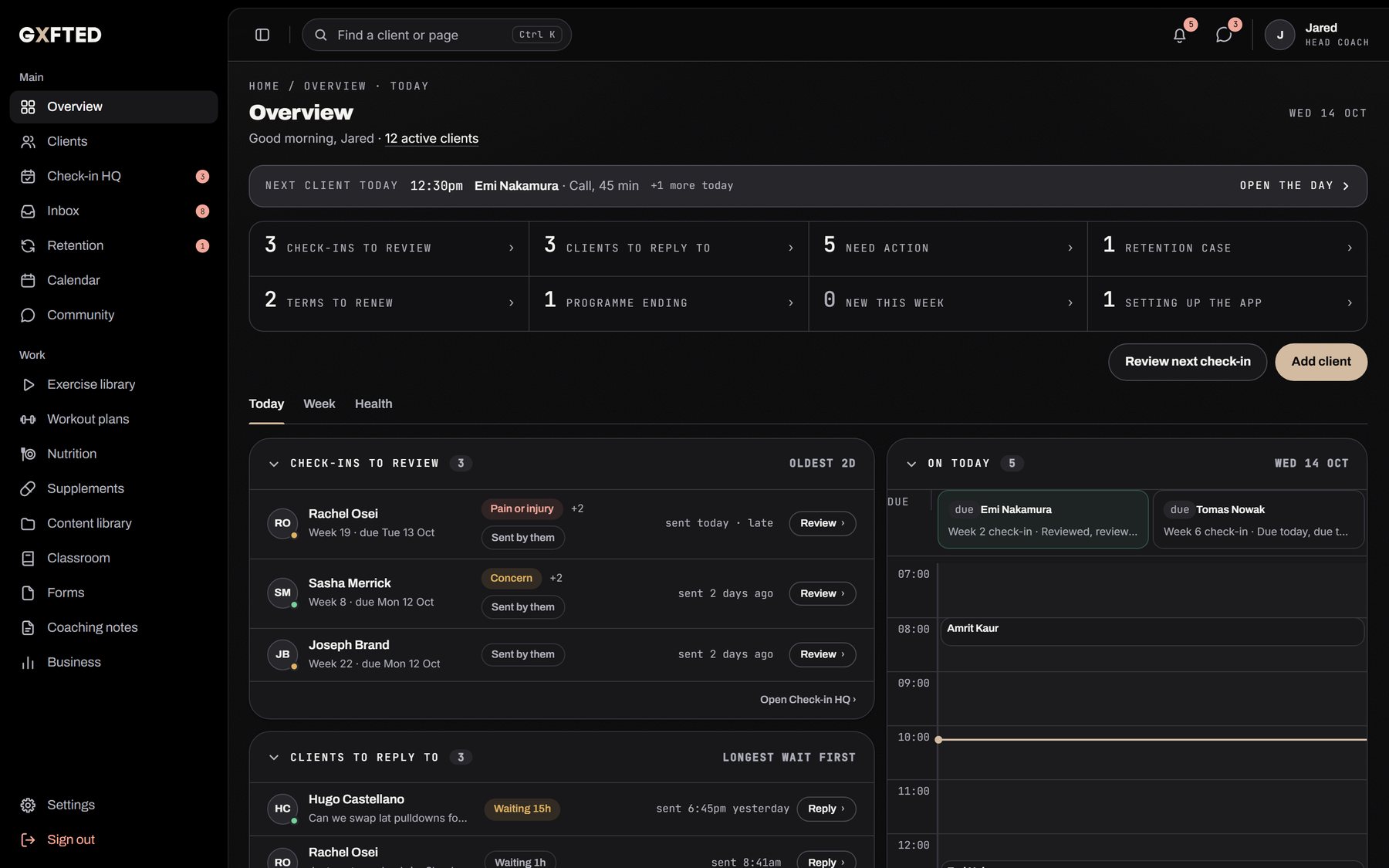
The Coach OS overview on a Wednesday morning: counters for check-ins to review and clients needing action, the check-ins waiting, the clients who need action and why, and today's calls
Overview at 10:15 on a Wednesday: three check-ins to review, who needs action and why, and today's calls. Every count is the length of the list it opens.

Who they are

GXFTED, short for Gifted X Aesthetics, is a premium coaching brand led from the front by an athlete who competes in Men's Physique at national level. Its promise is fewer clients, higher touch and no templates: every programme and every meal plan is written for one person.

Clients train in their own gyms and live on their own clocks. The coach needs to see at a glance who has checked in, who is drifting and what to change next. Each client needs one place for their training, their food, their check-ins and their coach.

How the week used to run

On a subscription coaching platform. It worked, but it was built for every coach, so the look, the rules about who could see what, and the shape of the week all belonged to the platform rather than to GXFTED.

For a brand whose whole position is that nothing is a template, the software was the one template left. The brief was to replace it with something that worked the way this business already coaches, and to carry everything worth keeping across with it.

What we built

One system with two doors. The coach and his team sign in to Coach OS with two-factor. Clients sign in to the GXFTED app, installed on their phone straight from the browser with no app store. Both sides read the same database, so a set logged in the gym, a meal ticked off or a check-in sent is in front of the coach as soon as it is saved.

Mornings start with who needs the coach

Overview opens on the day: check-ins waiting for review, the clients who need action and why, replies owed and today's calls. Every client carries a health band, green, amber or red, with the rule that set it written beside it, so a red is never a mystery. One set of rules decides whether a week is open, on time, late, chased or missed, and every screen asks those same rules, so no two screens ever disagree about a client.
A check-in review that shows the whole week

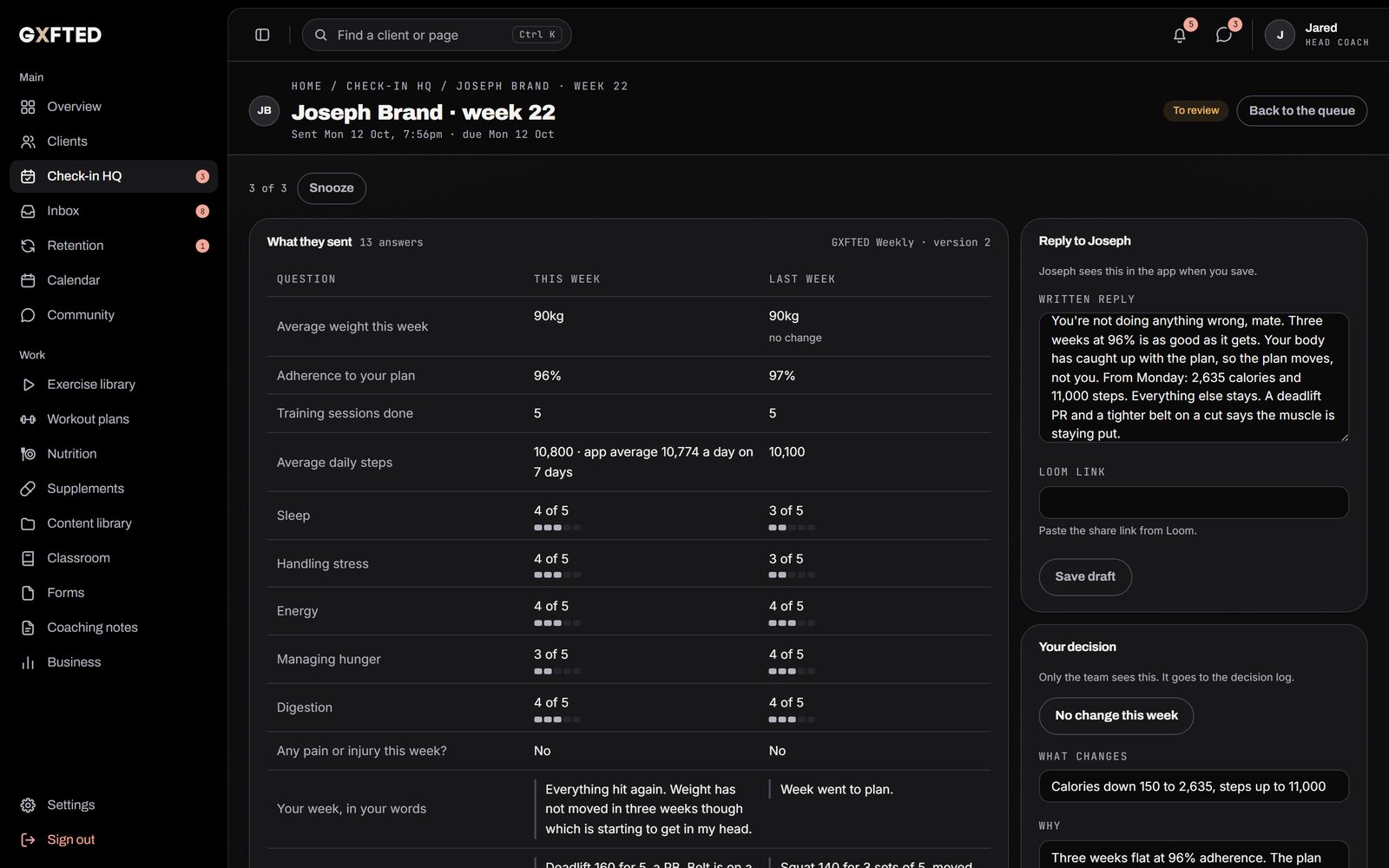
Clients send their weekly check-in from the app: weight, adherence, sessions, sleep, stress, energy, hunger and digestion, in their own words, with photos in a reassessment week. The review lays all of it beside the weight trend on a true scale and what they actually ate and lifted that week. The coach's adjustment is saved as a decision that can never be edited or deleted, so over months it becomes the record of why every change was made.

A weekly check-in under review: the client's answers, adherence and sessions, the weight trend across recent weeks, the week's eating and training, and the form to record the coach's adjustment
Joseph has hit 96% of his plan and his weight has not moved in three weeks. The review makes it plain the plan has stalled, not him, and the change is recorded against the week.

Programmes, and a workout logger that works with no signal

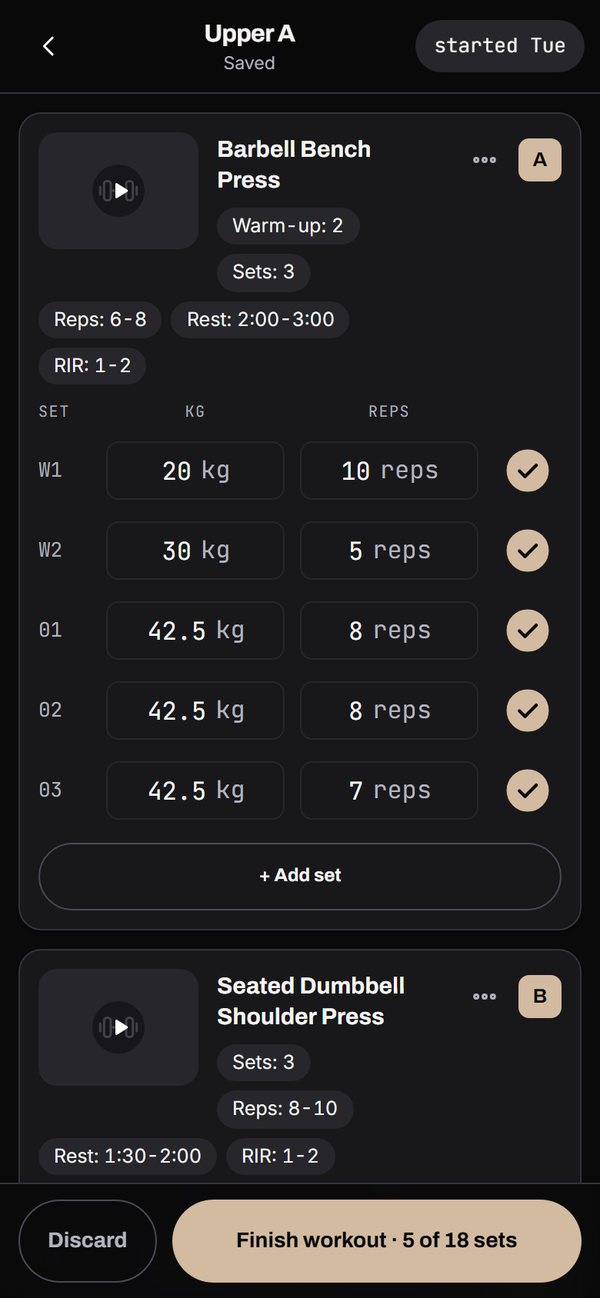
Programmes are built from a library of 246 exercises carried across from the old platform, with weeks, rep ranges, supersets and alternatives, then given to a client as their own copy. In the gym the client logs each set as they go. When the signal drops in a basement gym the logger keeps working and sends every set once, as soon as it is back.

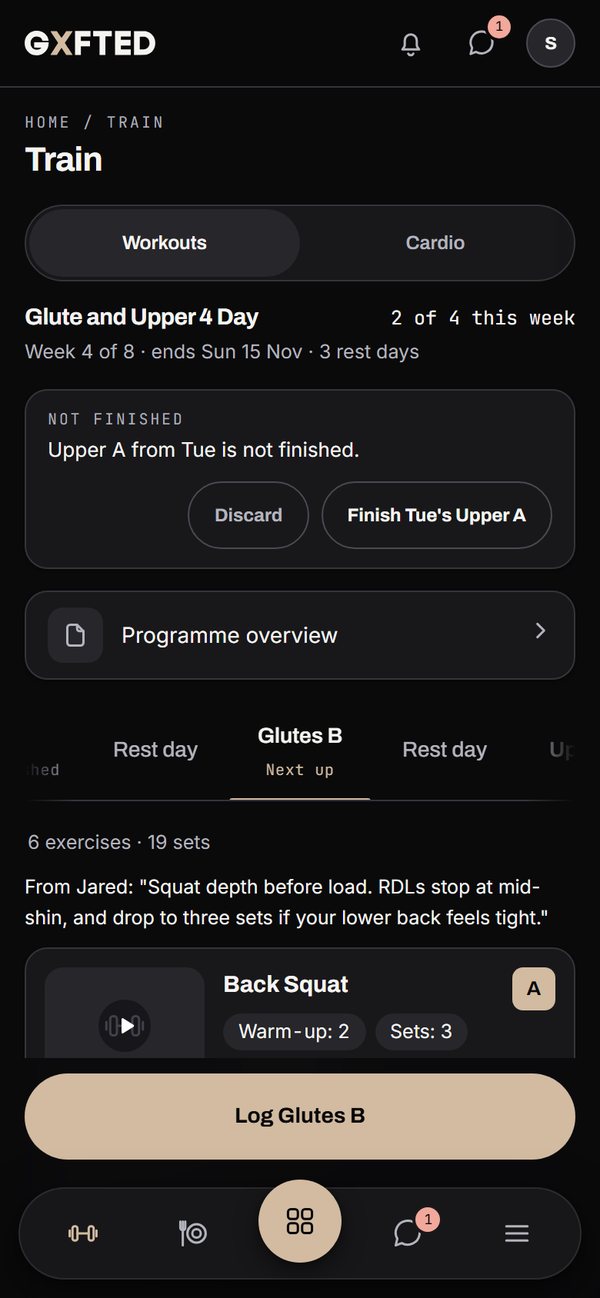
The Train screen on a phone, showing the client's programme week with each training day and what is next
The week's sessions, and what is next.
The workout logger on a phone part way through a session, with completed sets ticked and the weight and reps for each set
Sets logged as they happen, even offline.

Nutrition plans from 1,588 Australian foods

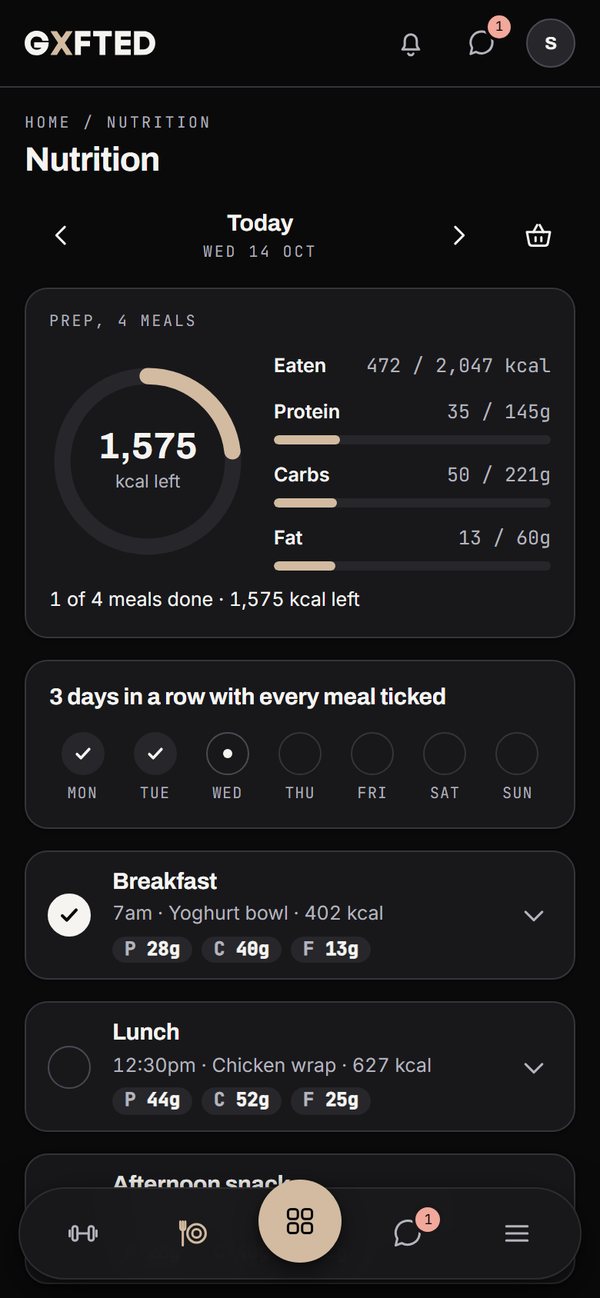
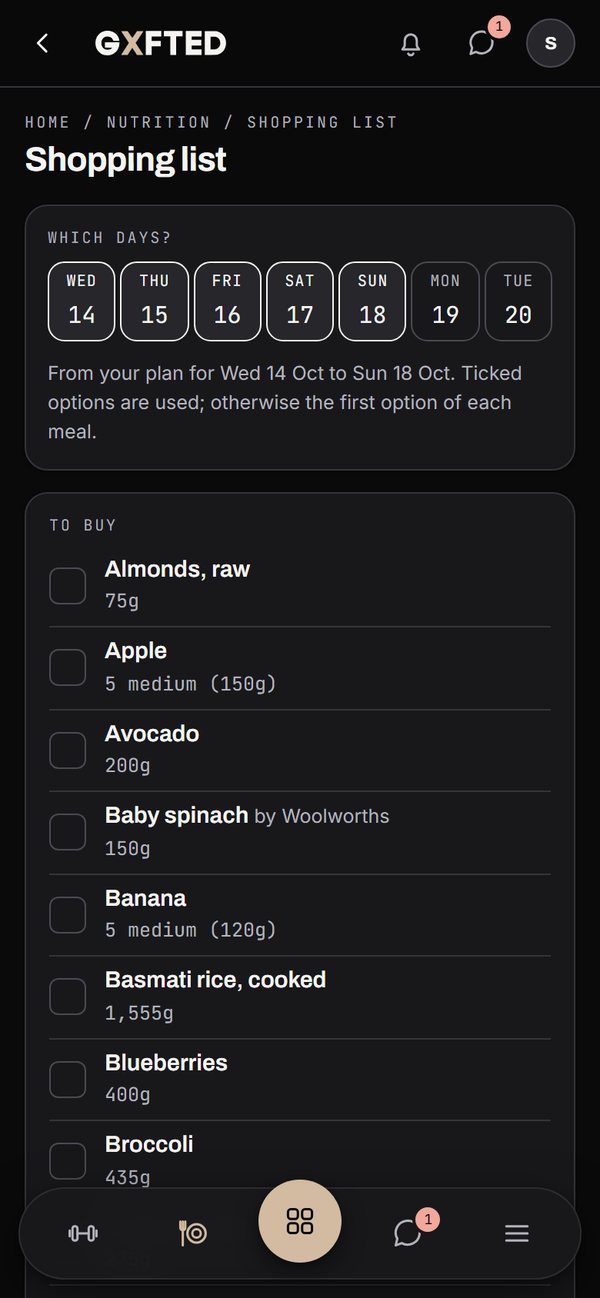
Meal plans are built from the Australian Food Composition Database, with packets added by scanning the barcode. Clients see today's meals and their options, tick them off, swap an option, and get a shopping list for the week. Supplements sit beside the plan, with the store's discount code one tap away.

Today's meal plan on a phone, with breakfast ticked off, the meals still to come and the day's targets
Today's meals, ticked off as they are eaten.
The shopping list on a phone, grouped by aisle with amounts for the week
The week's shopping, worked out from the plan.

Messages, calls and the nudges in between

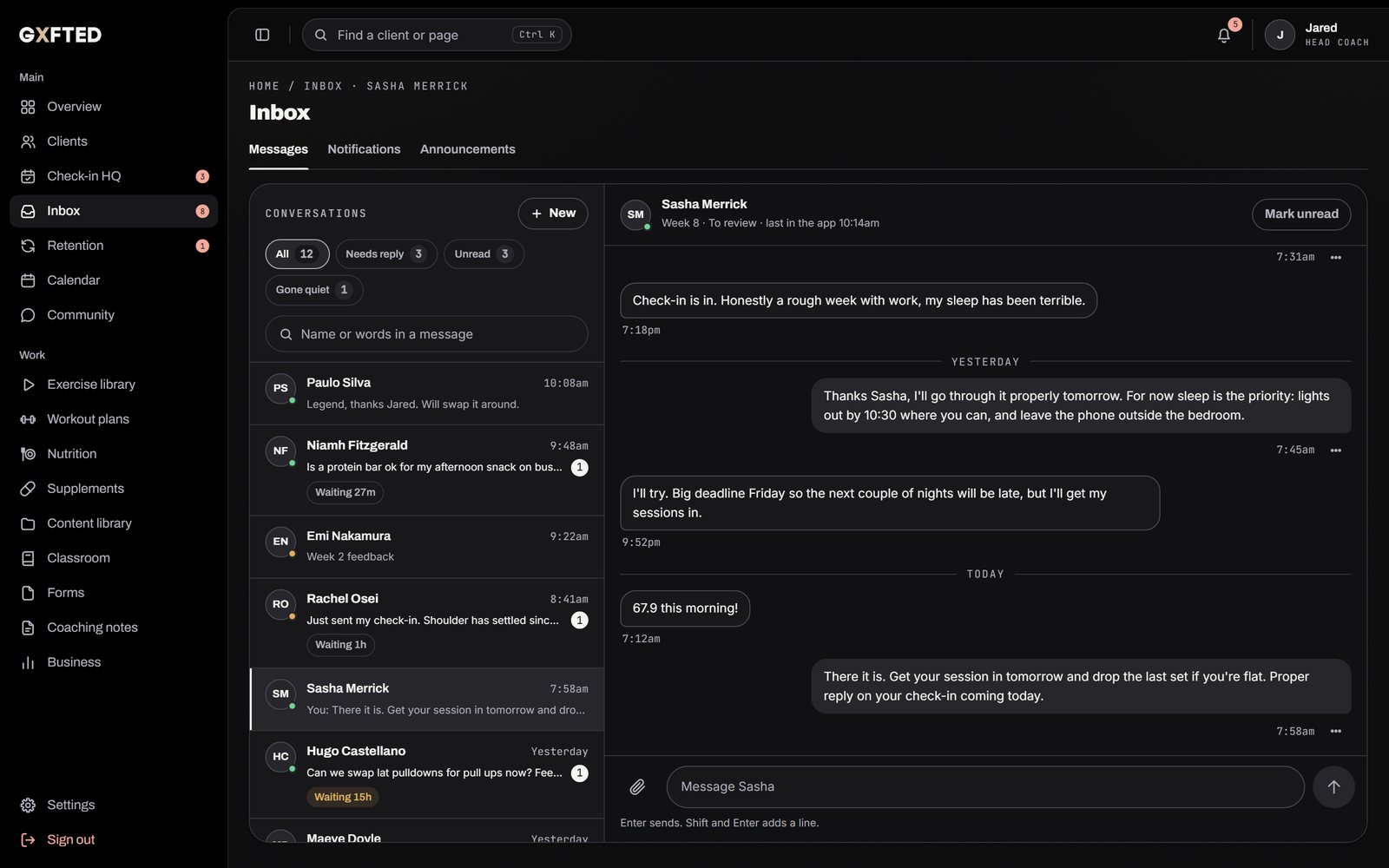
Coach and client message in real time, with a notification when a reply lands and quiet hours respected. Calls are booked against the coach's own hours, with reminders before each one. Check-in reminders go out on each client's own clock, and a late week is flagged for a chase before it ever becomes a missed one.

The coach's inbox, listing client conversations with the newest message from each and a thread open beside them
Every conversation, with who is waiting on a reply.
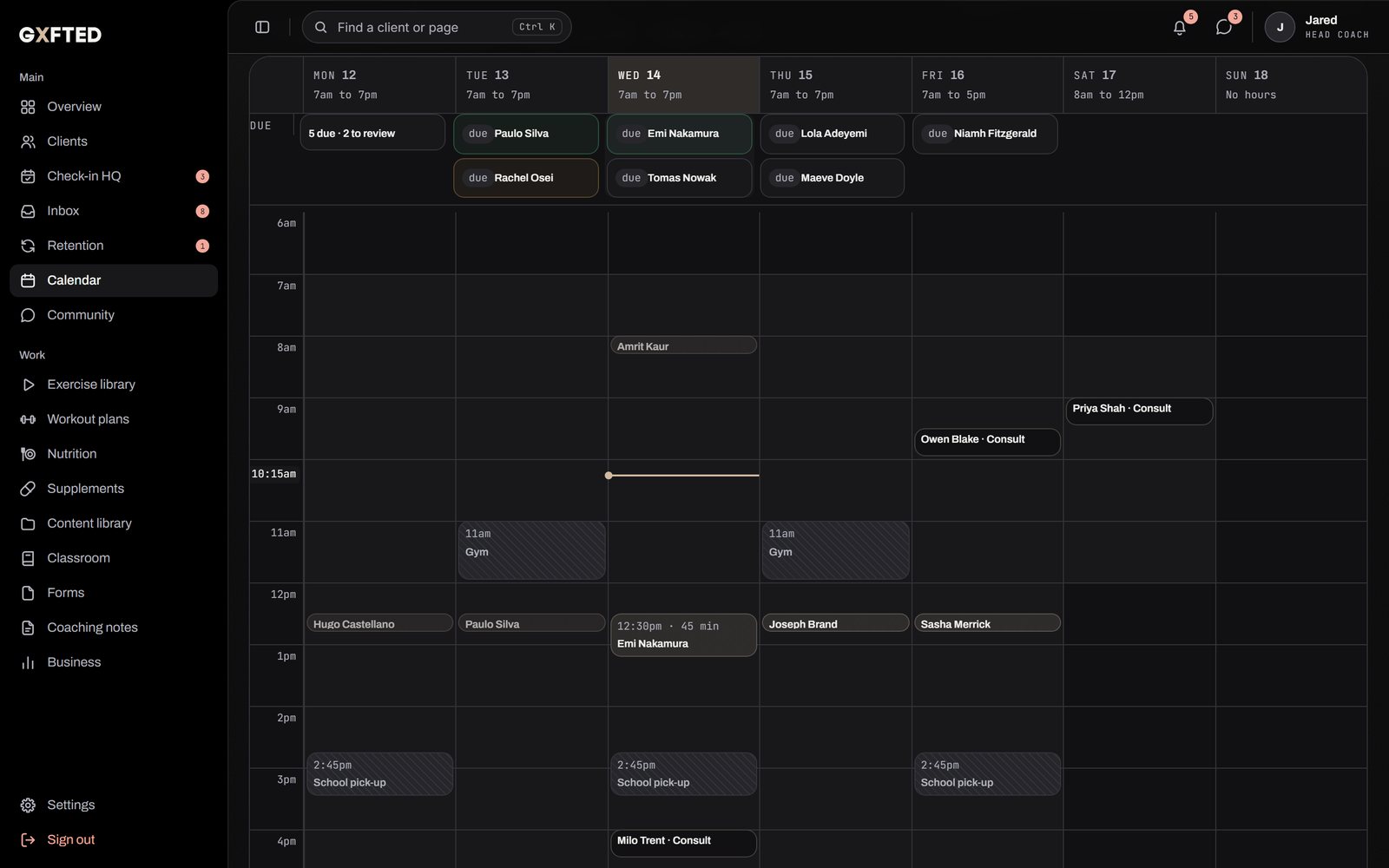
The coach's calendar for one week on an hours grid, with calls, consults and check-in due days
Calls, consults and check-ins on one week.

The business side, for the coach's eyes only

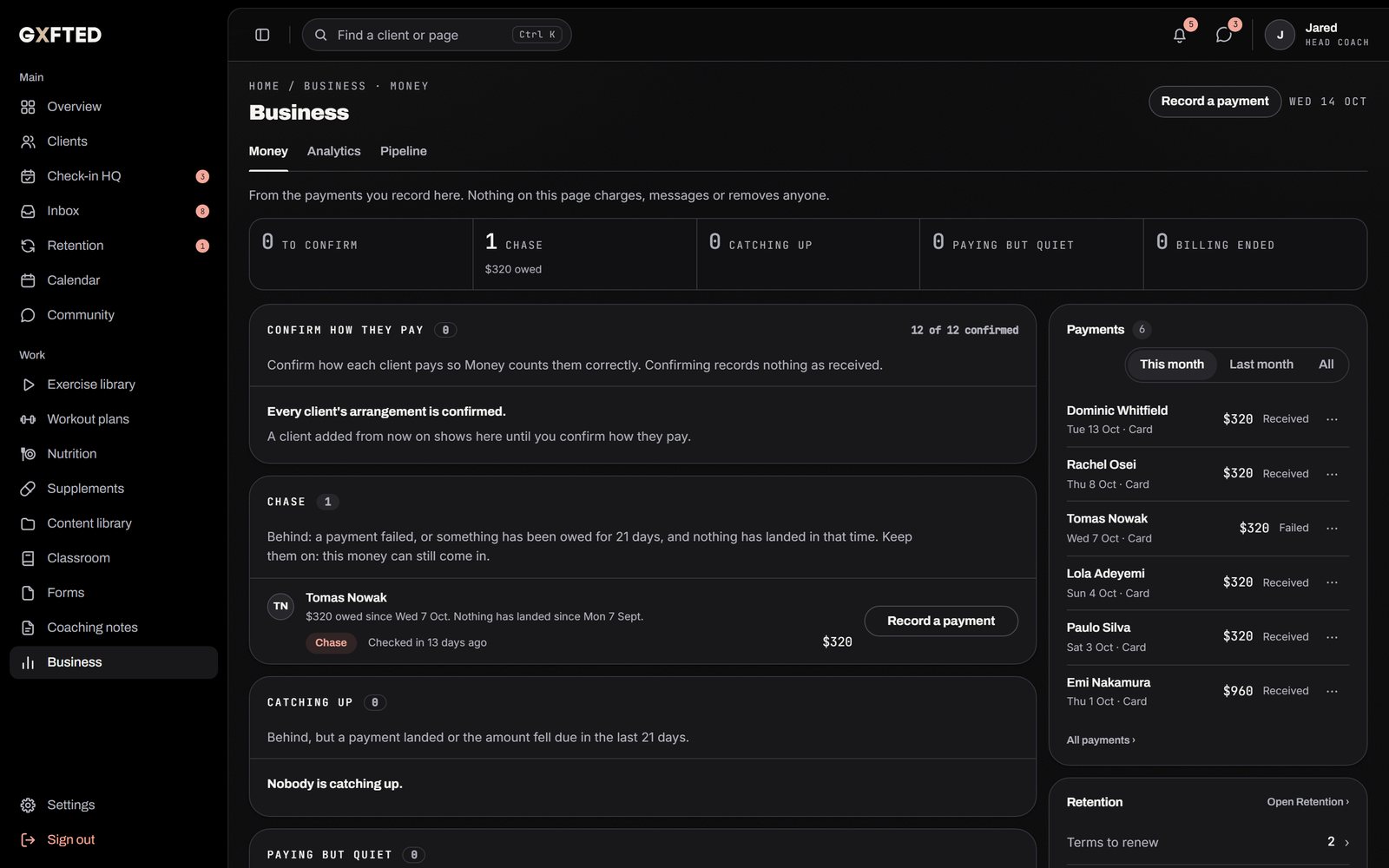
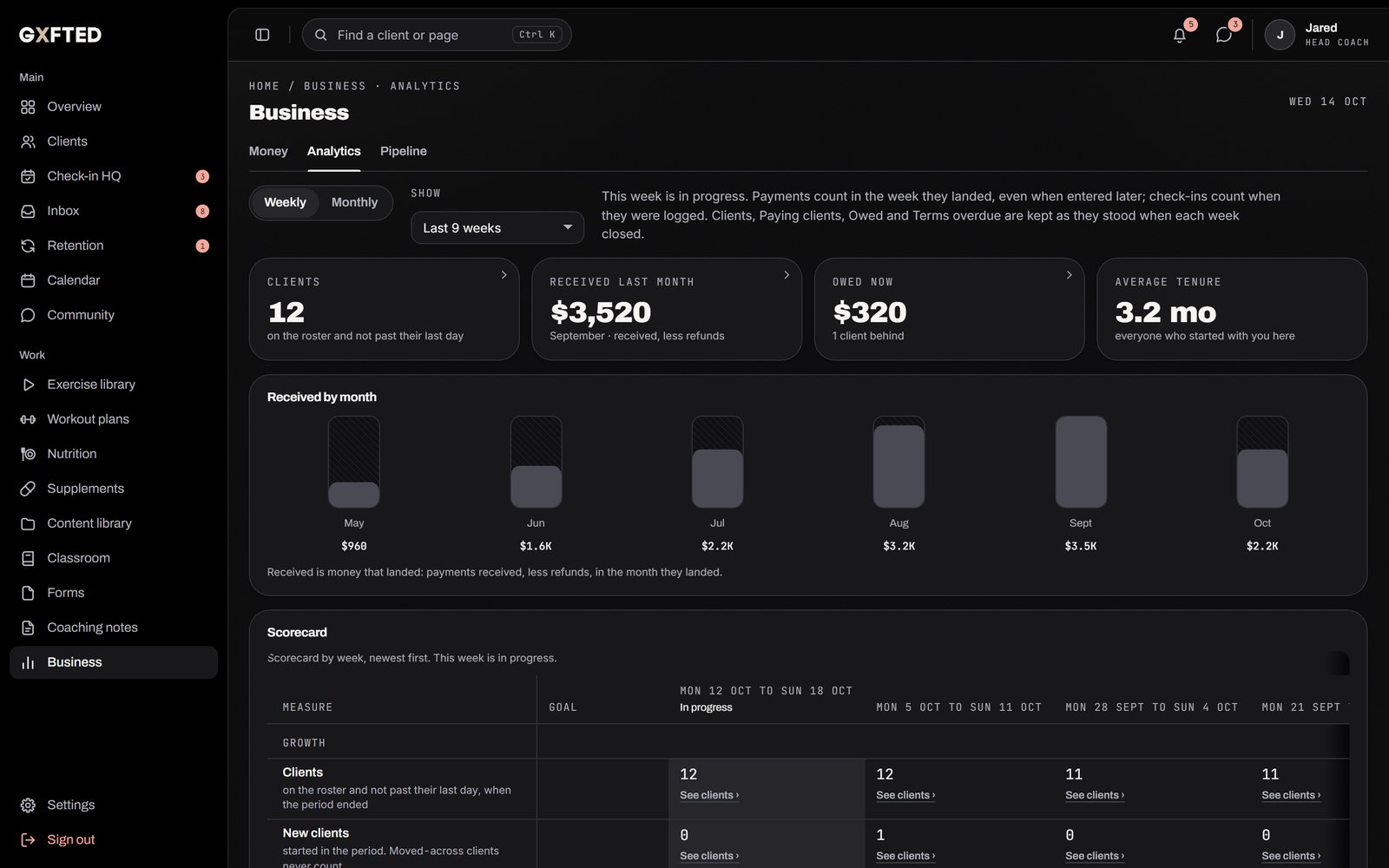
Money shows who has paid, who to chase and what landed each month. Analytics tracks seventeen measures week by week against the coach's own goals, and Pipeline follows every enquiry from first message to signed. Pauses, requests to stop and renewals each have their own lane. An assistant coach can work the roster all day and never see a dollar figure, because the database itself refuses to show one.

The Money screen, with money received by month and lists of clients to confirm, chase or follow up
What landed, and who to follow up.
The Analytics scorecard, with measures week by week against the coach's goals
Seventeen measures against the coach's goals.

Locked down like the health records they are

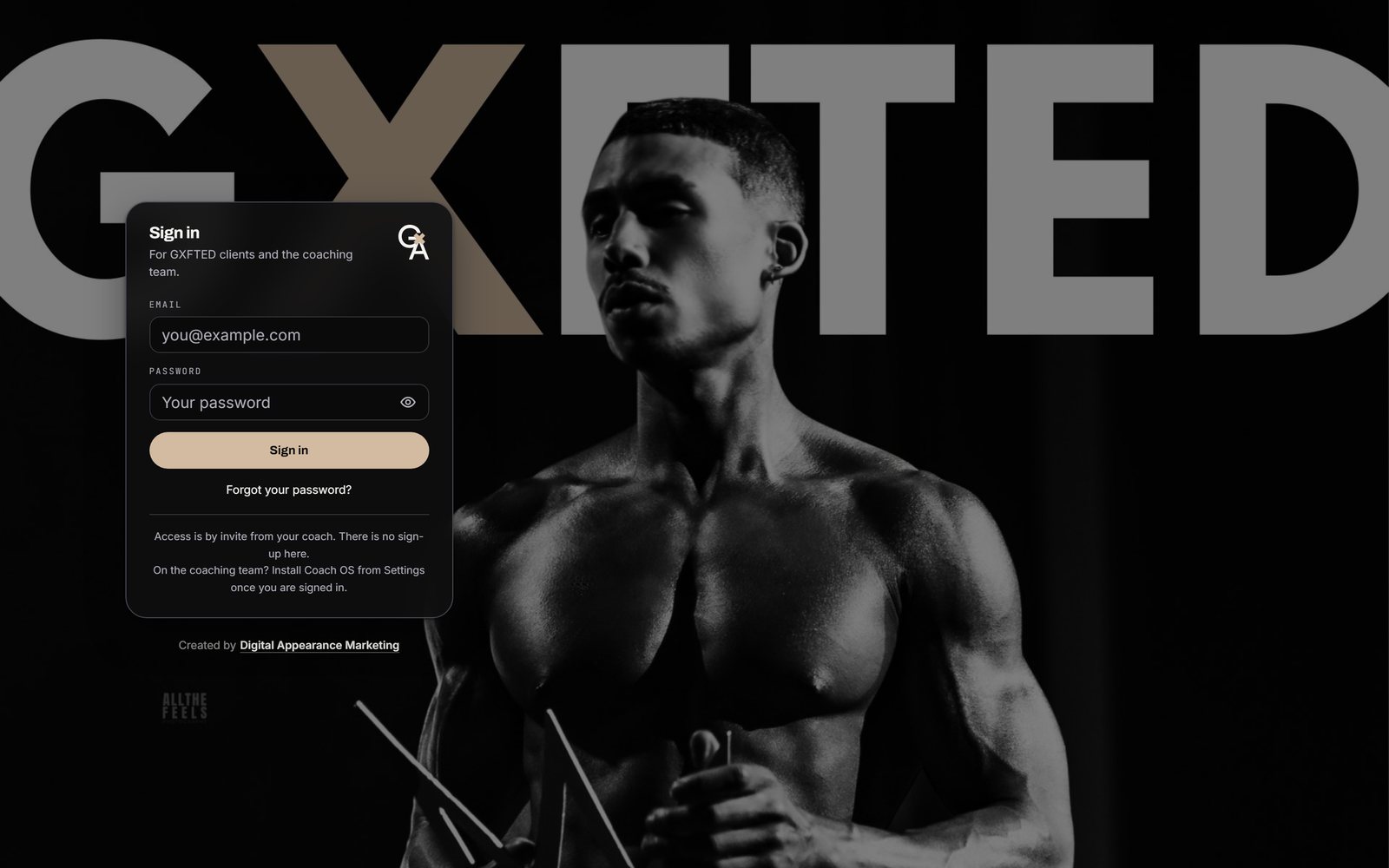
Weights, measurements, progress photos and injury notes are health information. Every table in the system sits behind row level security, proven by 2,428 automated checks run against the live database. Every team login needs two-factor, sign-in attempts are counted and slowed, bots that try the login service directly are stopped by a CAPTCHA, and progress photos only ever leave private storage through links that expire within ten minutes.

The GXFTED sign-in screen, a black and white photograph of the brand with the sign-in card on its dark left side
One door for clients and the team, in GXFTED's own look. The team meets two-factor next.

In every client's pocket

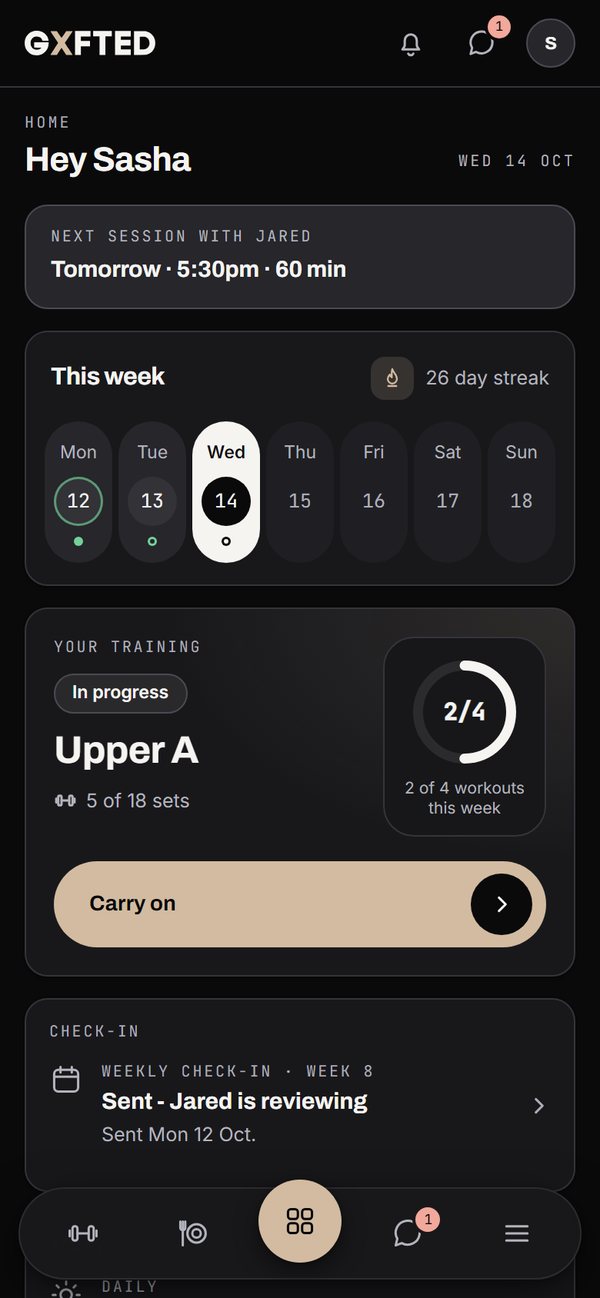
Clients open GXFTED to today: the session to train, the meals to eat, water and steps so far, their next call and the latest word from their coach. It installs to the home screen from the browser in three taps and sends notifications like any other app, without an app store in between.

The client app's home screen on a phone, with today's session, meals, water and steps, the next call and a note from the coach
Today, at a glance.
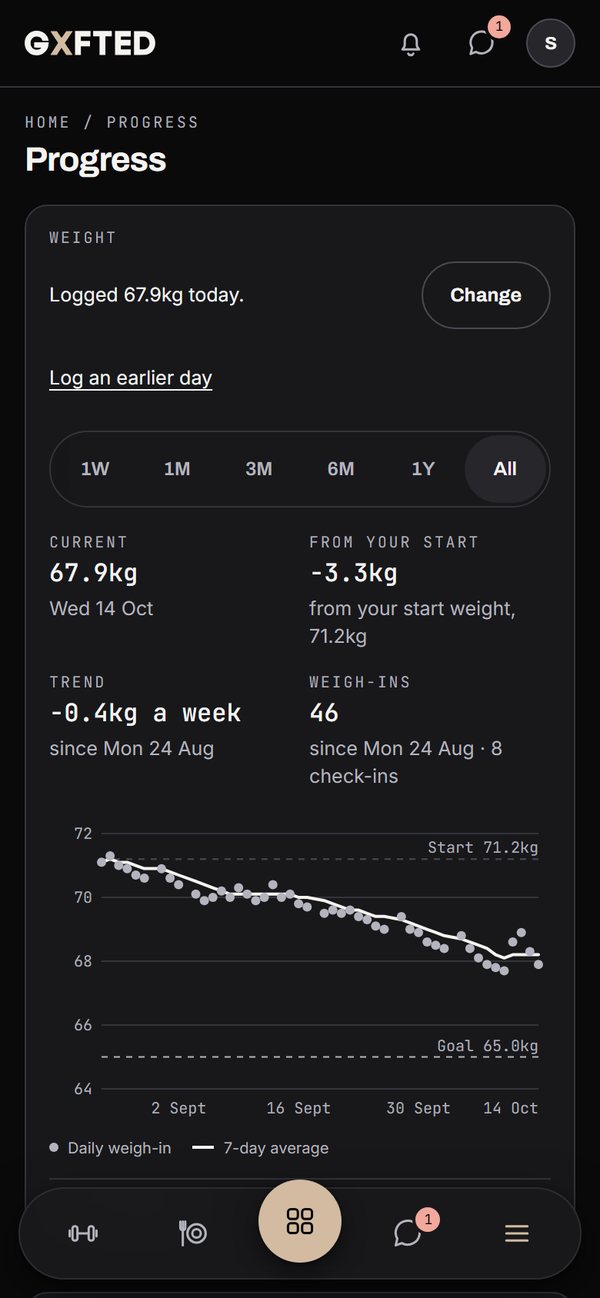
The Progress screen on a phone, with the client's weight trending down toward their goal
Progress toward their own goal.
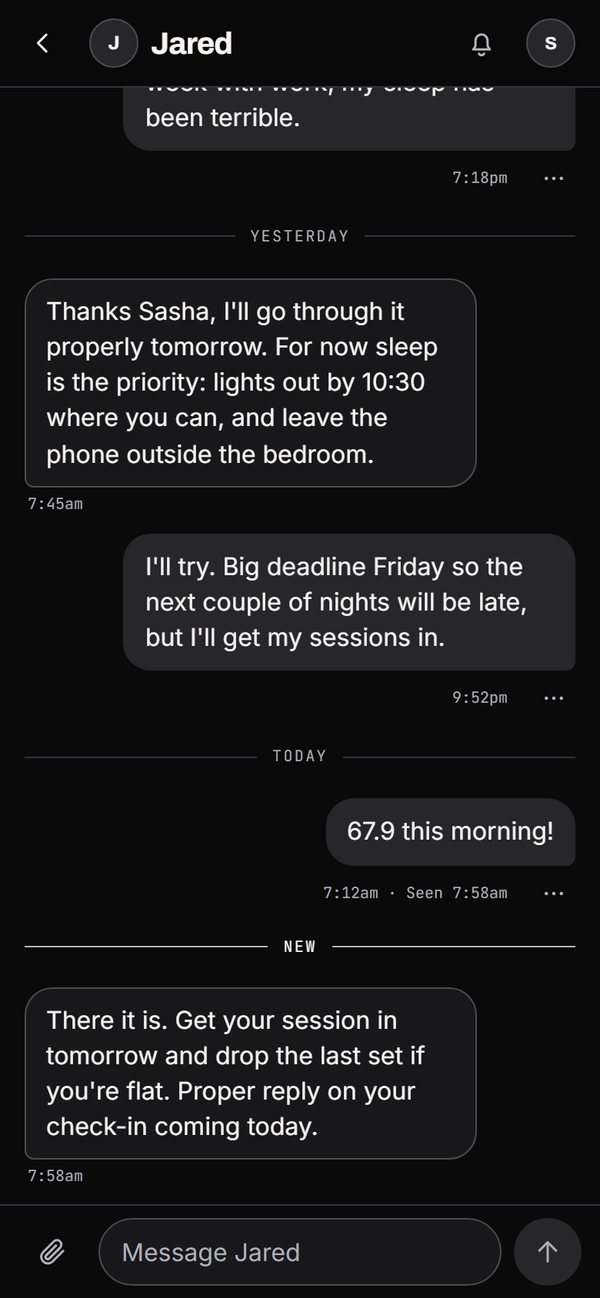
A message thread between a client and their coach on a phone
Their coach, one tap away.

How it was delivered

The first version, a console for the coach on his own, was built in the first days of September. In October it was rebuilt around everything the old platform did, plus the client app, in staged steps, each one tested end to end against the live database before the next one began. It was released six weeks after the first line of code, and clients move across in waves so nobody runs two apps at once.

We quote eight to fourteen weeks for the first release of a custom system; this one took six. Two apps, a team with its own access levels, payments and a client portal put it in what we price as a Platform build, from $70,000.

This is the kind of system we quote from a $2,500 discovery: one or two working sessions mapping how the work actually flows, then a written roadmap with the scope, a fixed price and the payback on paper. The discovery fee is credited against the build.

Another custom system The GIG Radiology staff portal Rosters, timesheets and leave for 45 staff across six medical imaging clinics, with 142 fortnightly timesheets into payroll and none of them re-keyed. Read that case study

Your turn

Is your business still fitting around someone else's software?

If your team works around a platform built for everyone, or your clients juggle three apps to deal with you, that is the conversation to have. Tell us how the week runs now and we will tell you honestly what it needs.

Start a project